
Agricultural solar setups are defined as systems that generate electricity from solar panels installed on or across farmland, either alongside or integrated with active food and livestock production. Known in the industry as agrivoltaics, these systems let you run a working farm and a power station on the same land at the same time. Agrivoltaic microclimate modification reduces crop heat stress and water loss, making solar a genuine climate adaptation tool, not just an energy cost fix. The examples below cover every major setup type, with real design figures and operational results to help you choose the right fit.
1. Examples of agricultural solar setups: elevated agrivoltaic systems
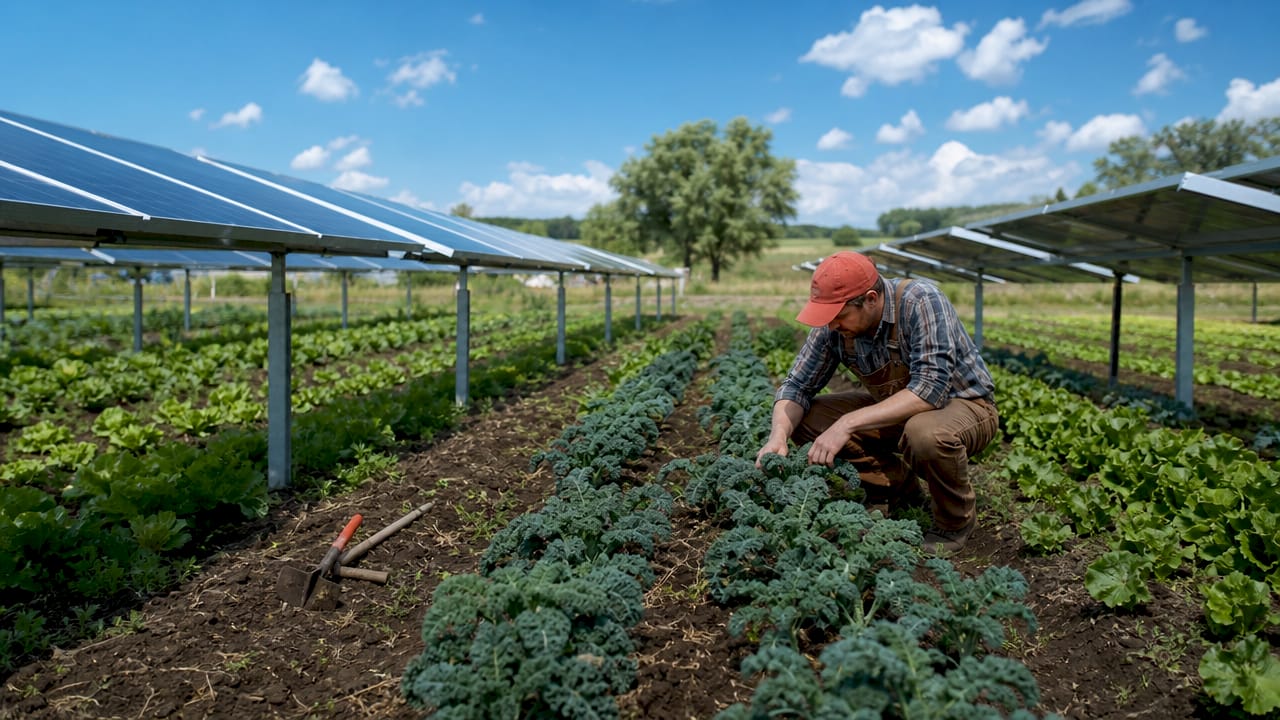
Elevated agrivoltaic systems mount solar panels high enough for tractors, harvesters, and cultivation equipment to pass freely underneath. Post-to-post spacing of 27 feet and panel height of 7–10 feet is the standard design benchmark for machinery clearance. That clearance means farming operations continue without modification to your existing equipment or workflow.
A working example is a 375 kW dual-use Massachusetts farm using bifacial modules on single-axis trackers, with rows spaced 27 feet apart across 2.2 acres. Bifacial panels capture reflected light from the ground below, increasing energy yield compared to standard single-face modules. The row spacing allows full tractor access while the partial shading from the panels reduces water evaporation and moderates soil temperature on hot days.
The microclimate benefits are measurable. Shading cuts thermal stress on crops during peak summer heat, which is particularly valuable for leafy vegetables, soft fruit, and root crops. The trade-off is a modest reduction in direct sunlight reaching the crop canopy, so elevated systems suit crops that tolerate or benefit from partial shade rather than full-sun varieties like maize.
- Panel type: Bifacial PV modules for maximum yield
- Row spacing: 27 feet minimum for standard tractor access
- Panel height: 7–10 feet above ground level
- Best for: Mixed arable, market gardens, and soft fruit farms
Pro Tip: Space rows to match your widest piece of machinery, not your average equipment. One oversized harvester that cannot pass will cost you more than any energy yield gain from tighter spacing.
2. Inter-row solar panel installations
Inter-row systems place panels at a lower height, typically 1–1.5 metres above ground, with wider gaps between panel rows to allow crop cultivation in between. The infrastructure cost is lower than elevated systems because the mounting structures are shorter and simpler. The trade-off is that machinery access is more restricted, making inter-row setups better suited to hand-harvested or low-clearance crops.
Crops that work well in inter-row systems include strawberries, herbs, salad leaves, and certain brassicas. These crops are naturally low-growing and tolerate the partial shading that inter-row panels create. Wider row gaps, typically 3–5 metres between panel rows, give enough light penetration for productive yields while still generating meaningful electricity.
Inter-row systems also suit livestock operations. Sheep and goats can graze between panel rows, controlling vegetation growth and adding a second income stream from the same land. Rotational paddocks are the recommended management approach, dividing the site into fenced sections grazed in sequence to keep vegetation even and prevent overgrazing in any one area.
- Panel height: 1–1.5 metres above ground
- Row gap: 3–5 metres for crop access and light penetration
- Best crops: Strawberries, herbs, salad leaves, brassicas
- Livestock use: Sheep and goat grazing for vegetation management
3. Roof-mounted solar PV on agricultural buildings
Roof-mounted systems use existing barn, storage building, or polytunnel roof space to generate electricity without occupying any arable or grazing land. This is the most common solar power example in farming because it requires no change to land use and causes minimal disruption to daily operations. The panels sit above the building, the farm carries on below, and the electricity feeds directly into the farm’s own supply.
Barns, grain stores, and machinery sheds are the most productive roof types because they offer large, unobstructed south-facing surfaces. A medium-sized dairy farm with a 20-metre barn roof can typically accommodate a system large enough to cover a significant portion of its electricity demand. Proximity to the main electricity consumer, whether a milking parlour, grain dryer, or cold store, keeps cable runs short and reduces installation cost.
Grant support makes roof-mounted systems financially attractive. Ireland’s TAMS 3 scheme covers 60% of eligible costs up to £90,000, with typical payback in 3–5 years through energy savings alone. Similar support mechanisms exist across the UK for agricultural buildings, making the financial case straightforward for most farm types.
- Best roof types: Barns, grain stores, machinery sheds, polytunnels
- Key advantage: No land use change required
- Payback period: 3–5 years with grant support
- Grant example: TAMS 3 covers 60% of eligible costs
Pro Tip: Size your system to match your farm’s actual electricity consumption. Oversizing without matching farm consumption reduces ROI because regulations in many regions require 100% on-site energy use, with no payment for grid export.
4. Livestock grazing compatible solar setups
Livestock-compatible solar setups combine energy generation with active grazing on the same site, producing two income streams from one piece of land. The most documented example is a 5 MW agrivoltaic system in Southern France across 11 hectares, where sheep graze under the panels at a stocking rate of 10 ewes per hectare. That system generates annual income of €420,000–480,000 and delivers a 42% increase in total land ROI compared to sheep-only operations.
The design logic is straightforward. Panels are mounted at a height that allows sheep to move freely underneath without damaging the array. The sheep graze the grass that would otherwise require mechanical cutting, reducing maintenance costs for the solar operator. The farmer benefits from grazing rights and the energy income, while the land produces more value per hectare than either use alone.
Vegetation management is the critical operational factor. Dividing the site into fenced rotational paddocks prevents patchy growth and overgrazing. Without rotational management, sheep tend to concentrate in shaded areas under the panels, stripping vegetation there while leaving exposed areas ungrazed and overgrown.
- System example: 5 MW, 11 hectares, Southern France
- Stocking rate: 10 ewes per hectare
- Land ROI uplift: 42% over sheep-only operations
- Management requirement: Fenced rotational paddocks
5. Tracking agrivoltaic systems
Single-axis tracking systems rotate panels throughout the day to follow the sun, increasing energy yield compared to fixed-tilt arrays. Single-axis tracking agrivoltaic systems cost only 11% more than standard ground-mounted PV, but deliver significantly higher land productivity when agricultural output is included in the calculation. That cost premium is modest relative to the combined energy and crop value the system generates.
Tracking systems also distribute shade more evenly across the crop canopy throughout the day. Fixed panels create a static shadow pattern that can suppress growth in permanently shaded strips. A tracking array moves that shadow, spreading light more evenly and reducing the yield penalty for crops grown beneath. This makes tracking systems particularly suited to elevated agrivoltaic designs where crop performance matters as much as energy output.
The Massachusetts farm example uses single-axis trackers precisely for this reason. The combination of bifacial modules and tracking maximises energy capture while the moving shadow pattern supports healthier crop growth underneath. The additional mechanical complexity of tracking systems does increase maintenance requirements, so factor that into your total cost of ownership calculation.
6. Comparison of solar agricultural setups
Choosing the right system depends on your land type, crop mix, machinery, and energy goals. Climate-driven design is critical: semi-arid regions often see crop yield boosts from agrivoltaic shading, while humid regions with lower solar intensity may see yield reductions. Match the system to your local conditions, not just the technology specification.
| Setup type | Land use impact | Best crop fit | Relative cost | Machinery access |
|---|---|---|---|---|
| Elevated agrivoltaic | Dual use, full farming | Arable, soft fruit | High | Full tractor access |
| Inter-row | Dual use, restricted | Strawberries, herbs | Medium | Limited |
| Roof-mounted | No land use change | Any | Low to medium | No impact |
| Livestock grazing | Dual use, grazing | Pasture | Medium | Sheep/goat access |
| Single-axis tracking | Dual use, full farming | Arable, mixed | Medium to high | Full tractor access |
For farms with large roof areas and high electricity demand, roof-mounted systems deliver the fastest payback with the least disruption. For farms with open arable land and modern machinery, elevated or tracking agrivoltaic systems offer the strongest long-term land productivity gains. Livestock farms with pasture land suit the grazing-compatible model, particularly where vegetation management is already a cost.
Pro Tip: Factor in your local grid connection capacity before committing to a system size. A large ground-mounted array that cannot export surplus power and exceeds your on-site demand will underperform financially regardless of its technical specification.
Key takeaways
The most productive agricultural solar setups combine energy generation with active farming on the same land, using design-specific spacing, height, and management to protect both outputs.
| Point | Details |
|---|---|
| Elevated systems need clearance | Panel height of 7–10 feet and 27-foot row spacing allows standard tractor access. |
| Roof-mounted suits most farms | Barns and grain stores offer large roof areas with no land use change required. |
| Livestock setups boost land ROI | Sheep grazing under panels can deliver a 42% increase in total land return. |
| Climate determines crop suitability | Semi-arid regions benefit most; humid regions require careful crop selection. |
| System sizing is critical | Match panel capacity to on-site electricity consumption to protect payback period. |
What I’ve learned from farm solar projects
The biggest mistake I see farmers make is treating solar as a one-size-fits-all product. A system that works brilliantly on a Hampshire arable farm may be the wrong choice entirely for a Welsh upland sheep unit. The technology is the same. The design, the sizing, and the integration with your farming system are where the real decisions happen.
Agrivoltaics genuinely excites me because it solves a problem that has held farm solar back for years: the perception that solar competes with food production for land. The evidence from semi-arid regions shows that shading can actually improve yields for certain crops. That changes the conversation entirely. Solar is no longer taking land away from farming. Done correctly, it is making the land more productive.
The vegetation management challenge in livestock systems is underestimated. Rotational grazing under panels sounds simple, but it requires the same discipline as any rotational grazing system. Farmers who already manage rotational paddocks adapt quickly. Those who do not will find patchy vegetation and frustrated sheep a recurring problem.
My honest recommendation: get a site-specific design before you commit to anything. The rural solar installation process involves more variables than a domestic installation, and the financial case depends on getting those variables right. Grant schemes like TAMS 3 are genuinely generous, but they reward well-planned projects, not rushed ones.
— Simon
How Smarthometechnical can help with your farm solar project
Farm solar installations require a different level of planning than domestic projects. Structural assessments, grid connection capacity, machinery clearance, and grant eligibility all need to be addressed before a single panel goes up.

Smarthometechnical specialises in solar panel installations for rural and agricultural properties, from roof-mounted systems on farm buildings to ground-mounted agrivoltaic arrays. The team understands the operational demands of working farms and designs systems that fit around your farming calendar, not the other way around. Whether you are looking to reduce electricity bills on a dairy unit or generate income from open arable land, Smarthometechnical can assess your site, identify eligible grant support, and deliver a system sized correctly for your needs. Contact the team for a consultation tailored to your farm.
FAQ
What is an agrivoltaic system?
An agrivoltaic system is a solar installation that generates electricity while allowing active farming, such as crop growing or livestock grazing, to continue on the same land. The term covers elevated arrays, inter-row systems, and livestock-compatible setups.
How much does a farm solar installation cost?
Costs vary by system type and size, but grant schemes such as Ireland’s TAMS 3 cover 60% of eligible costs up to £90,000, with typical payback periods of 3–5 years through energy savings.
Can tractors operate under solar panels?
Yes, provided the system is designed with sufficient clearance. A panel height of 7–10 feet and row spacing of 27 feet allows standard farm machinery to pass freely underneath elevated agrivoltaic arrays.
Which crops suit agrivoltaic systems best?
Crops that tolerate partial shade perform best, including strawberries, herbs, salad leaves, and brassicas. Semi-arid regions see the strongest yield benefits from agrivoltaic shading, while humid regions require more careful crop selection.
Do solar panels affect livestock grazing?
Solar panels are compatible with sheep and goat grazing when the site is divided into fenced rotational paddocks. Unmanaged grazing leads to patchy vegetation, so a structured rotation is required for the system to work effectively.
