
Solar panel lifespan is defined as the period over which a photovoltaic system generates electricity at an acceptable output level, typically 25 to 30 years for modern crystalline silicon modules. For Devon homeowners, extending that lifespan is not a matter of luck. It depends on specific, repeatable maintenance actions that address the degradation mechanisms most relevant to your local environment. Field data from NREL’s PV Lifetime Project shows that well-maintained panels retain roughly 86 to 87% of their initial output by year 25. That figure assumes median conditions. In Devon, where coastal salt spray, Atlantic storms, and the thermal stress of granite and slate rooftops all play a role, the difference between a well-maintained system and a neglected one can be measured in thousands of pounds of lost generation.
What factors most influence solar panel lifespan in Devon?
Understanding the solar panel lifespan factors list specific to Devon is the foundation of any effective maintenance strategy. The Kiwa PVEL 2026 PV Module Reliability Scorecard identifies five primary degradation mechanisms that threaten panel longevity across all climates. Each one is relevant to Devon in a specific way.
- Thermal cycling. Devon rooftops, particularly those built from granite or slate, absorb and release heat rapidly. This daily expansion and contraction stresses solder joints and cell interconnects over time. South-facing Devon rooftops receive strong afternoon sun that accelerates this cycle.
- Damp heat and moisture ingress. Devon’s Atlantic climate means high humidity and frequent rainfall. Moisture that penetrates panel seals causes corrosion of internal contacts and delamination of the encapsulant layer.
- Mechanical stress from wind and hail. South-west England experiences some of the UK’s highest wind speeds. Panels on exposed Devon granite rooftops face repeated mechanical loading that can cause microcracks in cells, reducing output without any visible external damage.
- Ultraviolet degradation. UV exposure degrades the encapsulant and backsheet over time, causing discolouration and reduced light transmission. West-facing Devon roofs receive prolonged afternoon UV exposure that compounds this effect.
- Potential-induced degradation (PID). This electrical phenomenon occurs when voltage differentials between cells and the panel frame cause ion migration, reducing cell efficiency. It is more pronounced in humid conditions, making Devon’s climate a relevant risk factor.
Degradation rates vary significantly based on installation quality and local environment, not just geography. A poorly installed system on a sheltered Devon hillside may degrade faster than a well-installed system on an exposed coastal rooftop.
Pro Tip: If your home has a slate or granite roof, ask your installer about panel mounting systems that allow adequate airflow beneath the modules. Ventilation reduces thermal cycling stress and slows moisture build-up, both of which are particularly relevant to why solar installation suits Devon slate roofs and granite rooftops.
How should you clean and maintain solar panels safely?
Cleaning is the most misunderstood aspect of solar panel maintenance in Devon. The instinct to blast panels with a pressure washer after a muddy winter is understandable, but incorrect cleaning methods accelerate lifespan risk by damaging anti-reflective coatings and compromising panel seals. Once those coatings are gone, UV degradation accelerates and output drops permanently.
The correct approach to solar panel maintenance in Devon follows a straightforward sequence:
- Assess before you act. Inspect panels visually from ground level using binoculars before climbing onto the roof. Look for bird droppings, lichen, heavy grime, or any visible cracking. Cleaning is only necessary when soiling is significant enough to affect output.
- Choose the right time. Clean panels during cooler parts of the day, early morning or late afternoon. Cleaning hot panels with cold water causes thermal shock that can crack cells. Avoid cleaning in direct midday sun.
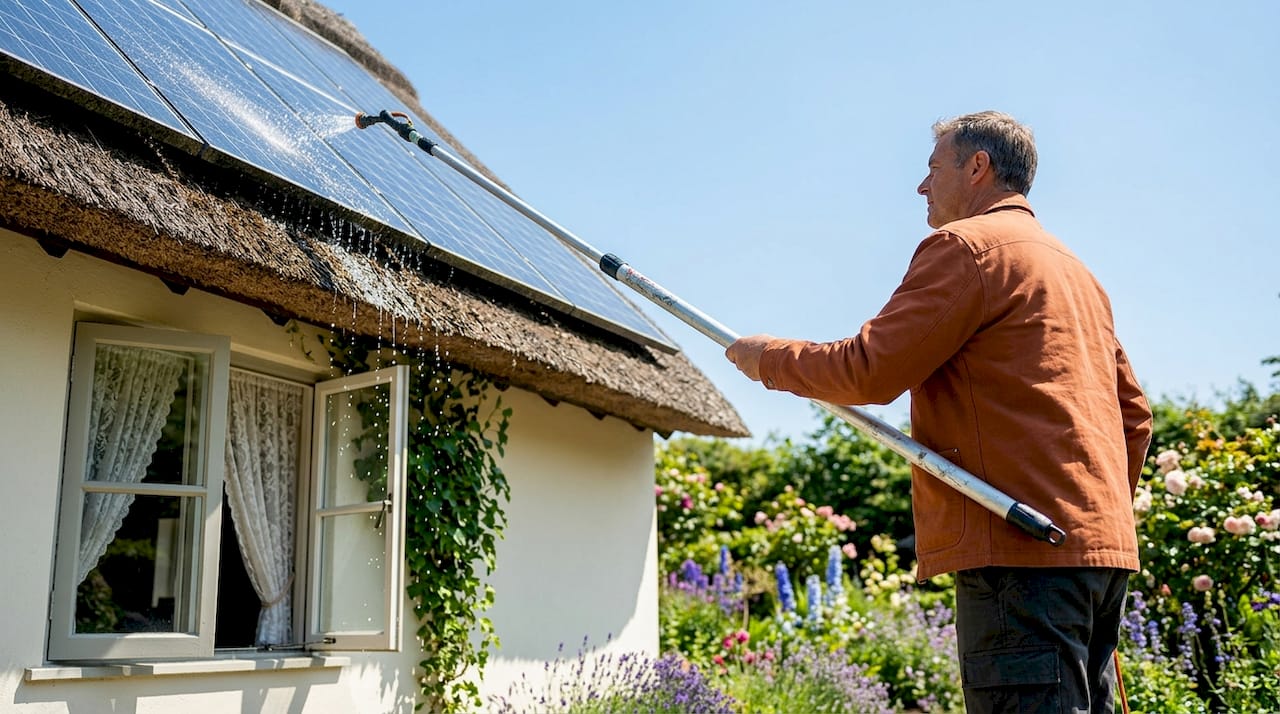
- Use plain water and a soft brush. UK guidelines recommend plain water with a soft-bristle brush or a squeegee on an extendable pole. No detergents, no abrasive pads, and absolutely no pressure washers.
- Work from the edges inward. Start at the panel edges and work toward the centre to avoid pushing grime into frame seals. Rinse thoroughly with clean water to remove any residue.
- Inspect seals and frames after cleaning. Once panels are dry, check frame corners and seal lines for any signs of lifting, cracking, or discolouration. These are early indicators of moisture ingress risk.
- Record the date and condition. Keep a simple log of each cleaning session, noting any observations. This record becomes valuable when making warranty claims or assessing degradation trends.
For most Devon homes, one to two cleans per year is sufficient. Coastal properties near the Exe Estuary or the North Devon coast may need an additional rinse in spring to remove salt deposits accumulated over winter.
Pro Tip: Extendable water-fed pole systems, the type used by professional window cleaners, are ideal for solar panel cleaning. They allow you to clean safely from ground level without accessing the roof, reducing both personal risk and the chance of accidental panel damage.
What role do inverters play in extending system lifespan?
The inverter is the component most likely to fail before your panels do. Inverters typically last 10 to 15 years, while quality panels are rated for 25 to 30 years. An inverter failure does not damage your panels, but it stops all generation until the unit is replaced. Undetected failures can mean weeks or months of lost output.
Effective inverter maintenance covers several areas:
- Cooling and ventilation. String inverters generate heat during operation. Check that the unit’s ventilation slots are clear of dust and debris at least twice a year. Blocked airflow causes overheating, which shortens component life significantly.
- Fan checks. Many inverters use cooling fans that wear out over time. A fan that runs noisily or intermittently is a warning sign. Replacing a fan costs far less than replacing the entire unit.
- Error log reviews. Modern inverters log fault codes and performance data. Review these logs every three to six months. Repeated error codes, even minor ones, often indicate developing faults that can be addressed before they cause full failure.
- Monitoring output data. A sudden drop in generation that does not correspond to weather conditions is almost always an inverter or wiring issue, not a panel problem. Catching this early prevents extended downtime.
- Planning for replacement. Planned inverter replacements aligned with warranty expirations minimise costly downtime. If your inverter is approaching the 10-year mark, budget for replacement proactively rather than waiting for failure.
Microinverters, which attach to individual panels rather than serving the whole array, typically last longer than string inverters and offer the added benefit of panel-level monitoring. They are worth considering when repowering an older Devon system.
How do warranties and repowering affect long-term value?
Understanding your warranty terms is as important as any physical maintenance task. UK solar warranties fall into two distinct categories, and confusing them is a common and costly mistake.
| Warranty type | What it covers | Typical duration |
|---|---|---|
| Performance warranty | Guarantees minimum output, usually 80% or above at year 25 | 25 years |
| Product defect warranty | Covers manufacturing faults, physical defects, and premature failure | 10 to 15 years |
Performance warranties guarantee minimum output of 80% or above at year 25, while product warranties cover manufacturing faults for a shorter period. If your panels are producing noticeably less than the warranted output, you have grounds for a claim. The key is having monitoring data that documents the underperformance over time, which is why consistent output logging matters from day one.
Repowering is the strategy of replacing degraded or failed components while retaining the existing infrastructure. Repowering replaces degraded panels or inverters while preserving mounting systems, wiring, and roof penetrations, extending operational lifespan at a fraction of total replacement cost. For Devon homeowners whose systems are approaching the 15 to 20-year mark, repowering is often the most cost-effective path forward. It also avoids the need for new planning permissions in most cases, since the roof structure and mounting points remain unchanged.
Before repowering, assess your roof condition independently. Replacing panels on a roof that needs re-slating within five years is poor economics. Coordinate the two projects where possible.
What are the most common maintenance mistakes to avoid?
Most premature solar panel failures in Devon are preventable. System monitoring data is the most reliable early warning tool available to homeowners, yet many systems are installed and then left unmonitored for years. By the time a problem becomes visible, significant output has already been lost.
The most damaging mistakes include:
- Walking on panels. Even panels rated for mechanical load are not designed for foot traffic. Microcracks caused by walking are invisible but permanently reduce cell output.
- Using detergents or chemicals. Household cleaning products strip anti-reflective coatings and degrade seals. Plain water is always sufficient.
- Ignoring delamination. Bubbling or yellowing beneath the panel surface is delamination. It progresses rapidly once started and voids most warranties if left unaddressed.
- Skipping post-storm inspections. After significant hail or storm events, inspect panels for physical damage before the next generation cycle. Devon’s Atlantic weather makes this a seasonal priority, particularly in autumn and winter.
- Assuming low output is normal. A gradual output decline of more than 1% per year is above the median annual degradation of approximately 0.5% for crystalline silicon modules and warrants investigation.
Pro Tip: Set a calendar reminder every six months to log into your inverter’s monitoring portal and compare current output against the same period in the previous year. A consistent decline of more than 5% year-on-year is a clear signal to call a professional.
Key takeaways
Extending solar panel lifespan in Devon requires consistent monitoring, careful cleaning, proactive inverter maintenance, and a clear understanding of warranty coverage to protect both output and investment.
| Point | Details |
|---|---|
| Annual degradation benchmark | Well-maintained panels retain around 86 to 87% output at year 25; above-average decline warrants investigation. |
| Cleaning method matters | Use plain water and a soft brush only; pressure washing and detergents permanently damage coatings and seals. |
| Inverter replacement planning | Budget for inverter replacement at the 10-year mark to avoid undetected generation losses. |
| Warranty types are distinct | Performance warranties cover output at year 25; product warranties cover manufacturing faults for 10 to 15 years. |
| Repowering extends system life | Replacing worn components while retaining existing infrastructure is cost-effective for systems aged 15 to 20 years. |
What I have learned maintaining Devon solar systems
After years of working on solar installations across Devon, the pattern I see most often is not dramatic failure. It is slow, unnoticed decline. A homeowner calls because their bills seem higher than expected, and when we pull the monitoring data, we find the system has been underperforming for two or three years. The panels are fine. The inverter threw a fault code eighteen months ago, nobody noticed, and it has been limping along at reduced efficiency ever since.
The single most valuable habit you can build is checking your monitoring data regularly. Not obsessively, but quarterly at minimum. Compare it against the same quarter the previous year. If the numbers are drifting downward faster than the expected 0.5% annual degradation, something is wrong and it is almost always fixable cheaply if caught early.
I also think the cleaning question is handled badly by most online advice. Devon rooftops do not need cleaning twice a year as a rule. A south-facing panel in mid-Devon with no overhanging trees might need one clean every 18 months. A panel beneath a popular starling roost needs attention every few weeks in winter. Look at your panels, not at a calendar.
The other thing I would say is this: do not let your warranty expire without reviewing your system’s performance data against the guaranteed output. Most homeowners never make a valid warranty claim simply because they do not know they have grounds for one. Your monitoring logs are your evidence. Keep them.
— Simon
Get expert solar maintenance support in Devon
Devon homeowners who want to protect their solar investment deserve more than generic advice from a manufacturer’s leaflet. Smarthometechnical provides professional solar panel services across Devon, from initial installation on slate and granite rooftops to scheduled maintenance visits and full system health assessments.

Our team of qualified electrical contractors understands the specific demands of Devon’s coastal climate, Atlantic weather patterns, and traditional roof construction. Whether you need a post-storm inspection, an inverter health check, or a repowering consultation for an ageing system, Smarthometechnical delivers the expertise to keep your panels generating at their best. Contact us to arrange a maintenance assessment and get a clear picture of where your system stands today.
FAQ
What is the average solar panel lifespan in the UK?
Most crystalline silicon solar panels are rated for 25 to 30 years. Field data shows panels retain approximately 86 to 87% of initial output at year 25 under median UK conditions, assuming proper maintenance throughout.
How often should I clean solar panels in Devon?
For most Devon homes, one to two cleans per year is sufficient. Coastal properties may need an additional rinse in spring to remove salt deposits, while panels near trees or bird roosts may require more frequent attention.
Can I clean solar panels myself safely?
Yes, using plain water and a soft-bristle brush on an extendable pole. Never use a pressure washer, detergents, or abrasive materials, as these damage anti-reflective coatings and seals, accelerating long-term degradation.
What is the difference between a performance warranty and a product warranty?
A performance warranty guarantees your panels will produce at least 80% of rated output at year 25. A product warranty covers manufacturing defects and physical faults, typically for 10 to 15 years. Both are separate documents and both matter.
When should I consider repowering rather than replacing my whole system?
Repowering makes sense when panels are still performing adequately but the inverter or other components have failed or degraded. Replacing only worn components while keeping the existing mounting infrastructure costs significantly less than a full system replacement.
