
A UK solar installation comes with at least three separate warranties, not one: a manufacturer product warranty on the panels, a manufacturer performance warranty on output, and an installer workmanship warranty on the fitting itself. In practice, the workmanship side, backed by insurance, matters more day to day than the headline 25 or 30 year manufacturer figure. Before signing anything, confirm the installer’s MCS certification and financial protection product, get the product and performance warranty terms in writing with your panel serial numbers, and check that monitoring has been commissioned. If any of those three checks come back vague, pause and ask for the paperwork before you sign.
TL;DR:
- Installer warranties are most valuable for workmanship, so verify that the installer’s insurance-backed workmanship guarantee is in place before signing.
- System components such as inverters typically have shorter warranties (5 to 10 years), making timely extensions or replacements crucial for long-term reliability.
- Standard warranties exclude damage from storms, vandalism, theft, corrosion without certification, and unauthorized repairs, requiring separate insurance coverage.
- The 2026 MCS scheme now mandates a minimum six-year financial protection product, making installer certification and warranty registration in your name critical.
- Proper documentation, including commissioning reports and serial numbers, is essential to streamline warranty claims and avoid delays or disputes later on.
Table of Contents
- The three warranty types on a UK solar quote
- How long each part of your system is actually covered
- What your warranty won’t cover, and where insurance has to step in
- The claims process step by step
- What a proper handover pack looks like
- Why the 2026 MCS changes matter more than a 25-year sticker
- Warranty risk is easier to manage before you sign than after a fault appears
- Where to check the details yourself
- Sources
- FAQ
The three warranty types on a UK solar quote
Every solar quote bundles together three legally and practically distinct warranties, and mixing them up is how homeowners end up chasing the wrong company when something goes wrong.
Product warranty. This one comes from the panel manufacturer and covers manufacturing defects: delamination (where the layers inside the panel start to separate), cracked cells, and faulty junction boxes. It does not cover damage from storms, misuse, or a botched install. Labour for a replacement is often excluded too, which catches people out, according to a breakdown of PV module warranty types from Energy Stack.
Performance warranty. This guarantees a minimum output curve over the panel’s life rather than protecting against a specific fault. Manufacturers express it as either a linear decline (a small, steady drop each year) or a stepped curve (a bigger dip in year one, then a slower fade). Either way, the wording tells you what percentage of original output is guaranteed at year 25, usually somewhere in the mid 80s to low 90s.
Workmanship warranty. This is the installer’s own promise covering how the system was fitted, roof penetrations, cable runs, isolator switches, and general wiring. It is the warranty most likely to be utilized, as installation errors become apparent sooner than manufacturing defects. Its value depends entirely on whether it is insurance backed.
- Product warranty: manufacturer, covers manufacturing defects in the panel
- Performance warranty: manufacturer, covers output maintenance over time
- Workmanship warranty: installer, covers the quality of installation
Inverters, batteries, and mounting systems each carry their own separate warranty terms again, on top of these three, usually from a different manufacturer than the panels themselves. A homeowner’s guide to how solar panel guarantees work walks through how these interact on a typical handover pack.
How long each part of your system is actually covered
Warranty length varies enormously by component, and the number on the brochure rarely tells the full story.
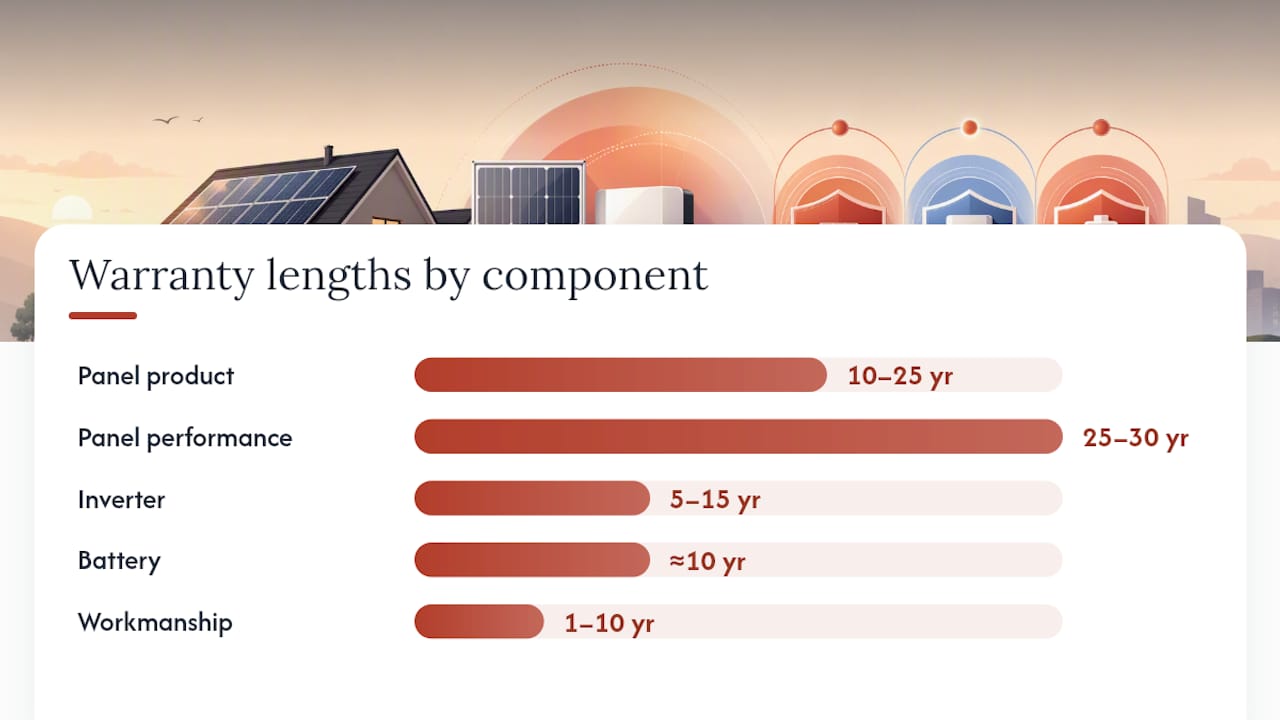
Panel product warranties range from around 10 years on budget panels to 25 years on premium tier one products. The gap matters less for the headline figure and more for what happens at each end: a cheap panel might guarantee 100% output in year one but drop off a cliff by year ten, while a premium panel holds a tighter curve throughout.
Panel performance warranties typically run for 25 to 30 years, guaranteeing that the panel still produces somewhere between 84% and 92% of its original rated output at year 25, according to modelling from a UK solar warranty calculator. Some manufacturers use a simple linear curve, others use a stepped one with a sharper first-year dip, then a gentler slope. Read the actual curve, not just the year 25 figure. A calculator applied to a 4kWp London installation with 2.6 peak sun hours and a 78% system derate factor shows how a guaranteed year 25 percentage translates into a specific guaranteed kWh output and, from there, a monetary floor over the warranty term.
Inverter warranties are usually the shortest of the major components, typically 5 to 10 years as standard, sometimes extendable to 12 or 15 for an extra cost. This is worth paying attention to, because the inverter is the part of the system most likely to fail first. It contains the only moving electronic components working hard around the clock, and a warranty types breakdown flags it as the component most likely to need replacing within the first 10 to 15 years. If an inverter extension is offered on your quote, it is usually one of the better value add-ons available.
Battery warranties are structured differently again, usually a mix of a time limit (commonly around 10 years) and a cycle or throughput limit, whichever comes first. Read the retained capacity threshold carefully.
Mounting and rails typically carry 10 to 20 year warranties, largely concerned with corrosion resistance and mechanical failure rather than output. Coastal properties should pay particular attention here, which the exclusions section below covers in more detail.
Workmanship or labour cover is the shortest and most variable line item, ranging from as little as 1 or 2 years on a bare minimum install to 10 years where the installer offers extended cover. This is the figure worth negotiating hardest on, since it is the warranty most likely to be called on in the real world.
What your warranty won’t cover, and where insurance has to step in
Every warranty document has an exclusions list, and it is usually longer than homeowners expect. Storm damage, hail impact, falling branches, theft, vandalism, and fire sit outside every manufacturer and workmanship warranty. So does pressure washing the panels yourself, and so does any unauthorised repair or alteration carried out by someone other than a certified installer.
Coastal and agricultural properties face extra considerations. Salt mist accelerates corrosion on standard panels and mounting hardware, so panels intended for coastal use should carry IEC 61701 salt-mist corrosion testing certification. Farm buildings near livestock face a similar issue with ammonia exposure, covered by the IEC 62716 standard. Fitting standard panels in either environment without checking these certifications can shorten the effective working life of a system well before any warranty period runs out, a point covered in more depth in a guide to why solar suits coastal properties.
- Storm, hail, and falling branch damage
- Theft, vandalism, and fire
- Pressure washing or unauthorised alterations
- Corrosion without IEC 61701 (salt mist) or IEC 62716 (ammonia) certification where relevant
Some manufacturers also write routine servicing requirements into their warranty terms, meaning a missed annual check or undocumented maintenance visit can technically void a claim. Keep dated records of any servicing carried out.
Pro Tip: Call your buildings insurer before installation, not after a claim, and ask them to confirm in writing that rooftop PV is covered under your existing policy. Some insurers want the panels specifically named on the schedule rather than assumed under general buildings cover.
The claims process step by step
Making a warranty claim in the UK follows a fairly predictable sequence, and knowing it in advance saves weeks of back and forth.
- Contact your installer first, not the manufacturer, with your full handover pack: MCS certificate, invoice, commissioning report, panel serial numbers, and monitoring data showing the fault.
- Expect diagnostic testing. For a suspected underperformance claim, this usually means an IV curve test or flash test carried out by the installer or a specialist, since manufacturers generally require lab-grade evidence before accepting a performance claim. This is also where cost risk can shift onto the homeowner if the fault turns out to be workmanship related rather than a manufacturing defect.
- If the installer has ceased trading, your first fallback is the insurance-backed guarantee or MCS-approved financial protection product attached to the installation. Your second is contacting the panel or inverter manufacturer directly using your serial numbers, since many major manufacturers maintain UK-based service partners independent of the installer.
- Know your statutory backstop. The Consumer Rights Act 2015 and Section 75 of the Consumer Credit Act 1974 (where the system was paid for partly by credit card) give you additional routes to a remedy, running for several years after purchase, on top of whatever the manufacturer or installer offers.
- Keep everything. Commissioning data, dated photographs of the installation, and periodic monitoring exports are what turn a disputed claim into an approved one.
Expect anywhere from a few weeks for a straightforward installer-handled fix to several months where lab testing or a manufacturer dispute is involved.
What a proper handover pack looks like
A defined handover pack on every installation is important, because a vague folder of paperwork is the single biggest reason warranty claims stall later on.
- MCS certificate showing the installation meets MIS 3002 standards
- Full commissioning report with test readings taken on the day
- Panel and inverter serial numbers logged against your address
- A live monitoring account set up and confirmed working before the installer leaves site
The most common issues seen in the first 12 months are rarely dramatic: a missing commissioning record, a monitoring app that was never actually activated, or minor water ingress around a roof penetration. Every one of these is far easier to resolve with dated photos and a documented handover than without. It’s also worth asking your installer whether an inverter warranty extension makes sense for your setup, and whether the workmanship warranty and any financial protection product can be registered directly in your name rather than left with the installer’s own account, since that affects what happens if you sell the property.
Why the 2026 MCS changes matter more than a 25-year sticker
Homeowners fixate on the panel’s headline product warranty, and it is the wrong thing to focus on. The MCS scheme’s redeveloped structure now requires installers to hold an MCS-approved financial protection product covering a minimum of six years per installation, a direct response to the damage done when installers folded and left customers with unenforceable workmanship promises. A 25-year manufacturer warranty is close to worthless if the installer carries no insurance-backed guarantee, or if the panel manufacturer has no UK service partner to action a claim against.
Ask any prospective installer three things: the name of their MCS-approved financial protection product, their MCS certification number, and who registers the warranty documents, and in whose name. Get the answers in writing before you sign anything.
— Simon
Warranty risk is easier to manage before you sign than after a fault appears
The whole warranty picture should be handled from the first site visit, not just the panels going on the roof. Installations should be MCS certified with full commissioning and monitoring set up before the team leaves site, and IBG or MCS-approved financial protection handled as standard, so the paperwork exists from day one rather than being chased after a fault appears.

If you already have solar and want ongoing peace of mind rather than a one-off install, the Solar & Battery Service & Maintenance Plan covers scheduled servicing and fault diagnosis for £175 per year, which keeps your maintenance records intact for exactly the kind of documented history a warranty claim later needs. For a new installation, check out the solar installation services page and ask directly about MCS certification, financial protection product, and warranty registration before you commit to a quote.
Where to check the details yourself
Verify warranty terms against primary sources rather than a salesperson’s summary. Check installer credentials on the MCS certification directory, review your statutory rights on Gov, and model your own system’s output floor with a performance warranty calculator. Save your panel datasheet and serial numbers the day of installation, not months later.
Sources
FAQ
Is the EU two year warranty valid in the UK?
The EU’s two year minimum guarantee no longer applies in the UK following Brexit. UK consumers instead rely on the Consumer Rights Act 2015, which gives goods a reasonable expectation of lasting several years, alongside whatever specific product, performance, and workmanship warranty terms the manufacturer and installer provide.
What is the average lifespan of solar panels in the UK?
Most panels installed in the UK continue producing usable electricity for 25 to 30 years, though output gradually declines over that period according to the panel’s performance warranty curve. Panels rarely stop working outright; they simply produce less than their original rated output as they age.
Is there a six year warranty in the UK?
Yes, under the MCS scheme’s redeveloped requirements, installers must now hold an MCS-approved financial protection product covering a minimum of six years per installation. This protects homeowners against workmanship claims and deposit loss if the installer stops trading, separate from any longer manufacturer product or performance warranty.
Are solar panels worth it in 2026 in the UK?
For most households with a suitable roof, solar remains financially worthwhile in 2026, particularly when paired with battery storage to capture more of the generated electricity. The value depends heavily on getting the warranty and installer protection right from the outset. A full-service solar installation with proper MCS certification and financial protection reduces the risk of an unenforceable warranty undermining that value later.
How do I make a solar panel warranty claim in the UK?
Contact your installer first with your full handover pack, including the MCS certificate, commissioning report, and panel serial numbers. If diagnostic testing confirms a genuine fault, the installer or manufacturer typically resolves it directly; if the installer has ceased trading, fall back on the insurance-backed guarantee or MCS-approved financial protection product tied to the installation.
